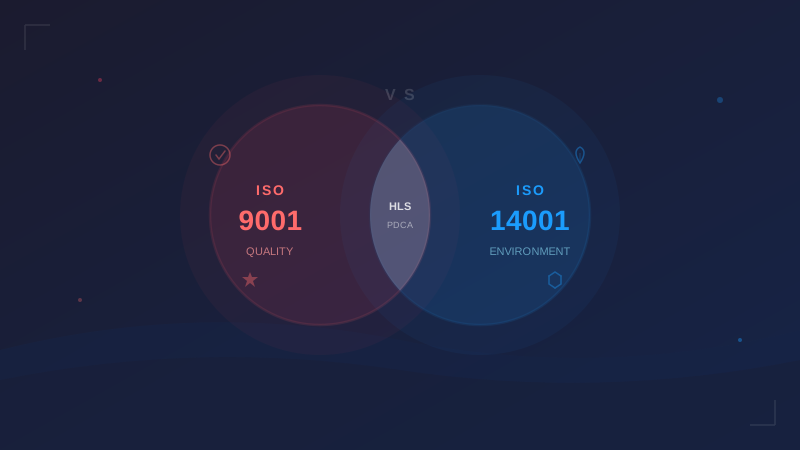
ISO 9001 and ISO 14001 are among the most widely deployed standards in the world. While they share a common structure (the HLS - High Level Structure), they address quite different objectives. Here’s a breakdown.
ISO 9001: quality in the service of the customer
ISO 9001 is the reference standard for Quality Management Systems (QMS). Its primary objective is to ensure customer satisfaction by providing products and services that meet requirements.
Key points:
- Customer focus and satisfaction
- Process approach
- Continuous performance improvement
- Management of quality-related risks and opportunities
ISO 14001: environmental performance
ISO 14001 governs Environmental Management Systems (EMS). It aims to reduce the environmental impact of an organisation’s activities.
Key points:
- Identification of significant environmental aspects
- Environmental regulatory compliance
- Pollution prevention
- Continuous improvement of environmental performance
Detailed comparison
| Aspect | ISO 9001 | ISO 14001 |
|---|---|---|
| Focus | Customer satisfaction | Environmental impact |
| Stakeholders | Primarily customers | Community, regulators, society |
| Risks managed | Product/service quality | Pollution, waste, resources |
| Legal obligations | Product requirements | Environmental regulations |
| Typical KPIs | Satisfaction rate, non-conformities | Energy consumption, emissions, waste |
What they have in common
Thanks to the HLS (High Level Structure), both standards share:
- The same 10-clause structure
- The risk and opportunity approach
- The requirement for leadership and management commitment
- The concept of continuous improvement (PDCA cycle)
- Documentation and competence requirements
The Integrated Management System (IMS)
The common structure facilitates the integration of both standards into a single system. The advantages:
- Less documentation: common procedures (management review, internal audits, non-conformity management)
- Consistency: a single quality-environment policy
- Efficiency: combined audits, less redundancy
- Savings: reduced certification costs (combined audit)
Which standard should you start with?
Start with ISO 9001 if:
- Your customers require it
- You want to structure your processes
- Quality is your strategic priority
Start with ISO 14001 if:
- Your sector is subject to heavy environmental regulation
- You want to reduce your energy costs
- Environmental image is a commercial concern
Ideally: implement an IMS from the outset to avoid rebuilding the system later.
Conclusion
ISO 9001 and ISO 14001 are not competitors but complementary. Together, they form the foundation of high-performing and responsible management. Investing in an integrated system is a lever for sustainable competitiveness.
Need help choosing the right approach? Browse our training programmes or contact our experts .